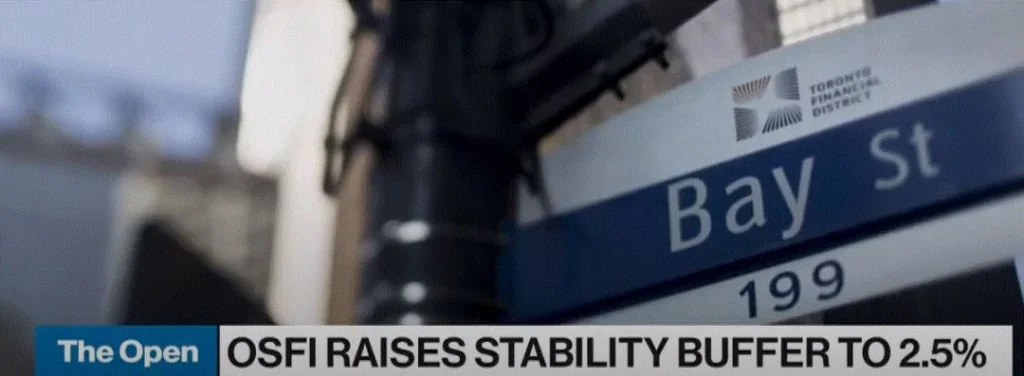
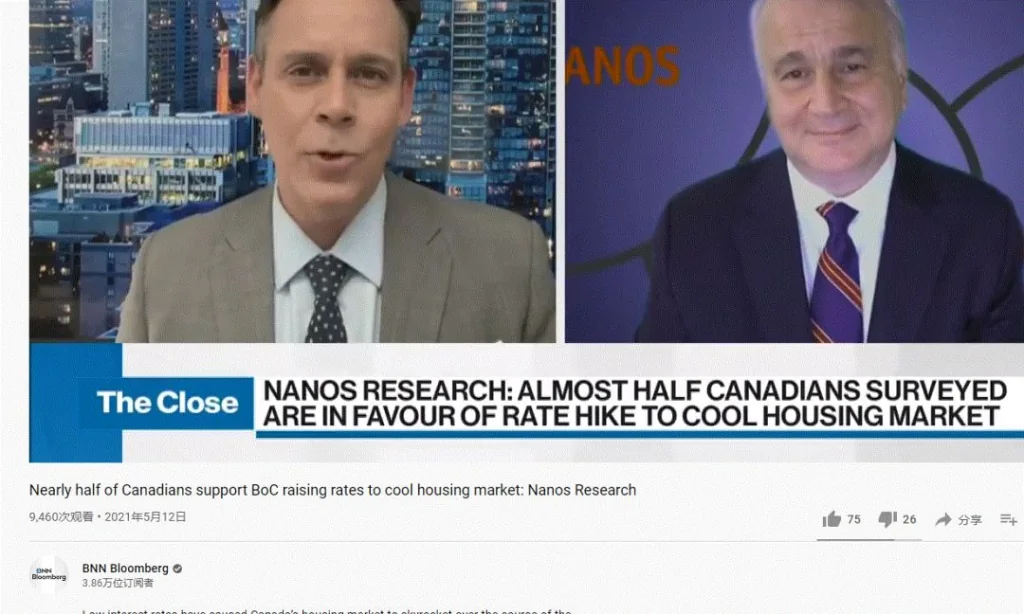
Starting from September 1, 2018, Canada and China began to exchange financial information with each other. This system is called CRS (Common Reporting System). Prior to the implementation of this policy, various professionals were extremely active, with some explanations bordering on intimidation. This system is only for "foreigners", and this foreigner specifically refers to "non-residents" in the sense of tax reporting. Most overseas students are residents in the sense of tax reporting, not non-residents; what is exchanged is asset information in financial accounts, and does not include debt information such as mortgages. Think back to how many people advised non-residents to buy houses with cash. The most critical thing is that until today, no professional has correctly told non-residents where the entrance to the CRS system is and how to correctly handle the entrance problem. The Canada Revenue Agency will automatically exchange the financial asset information of non-resident Chinese in Canada to China. In the opposite direction, China will also exchange the financial asset information of non-resident Canadians in China to Canada. In determining who is included in this CRS When the system was established, Canada set the entrance at commercial banks instead of the tax bureau. When you go to a bank to open an account with a non-resident certificate, the bank staff will ask "Are you a Canadian tax resident?" If your answer is "no" (note that many international students answer incorrectly), you must answer the next question "In which country do you file tax returns?" If you answer "China", then the CRS is set up. As long as you do not actively change it, the financial asset information will be automatically sent to the Canada Revenue Agency every year, and then reported to the China National Taxation Bureau by the Canada Revenue Agency. Professionals, such as immigration consultants and accountants, have not taught non-residents how to answer bank account opening questions. Accompanying my mother, I came to Canada with a visit visa, and then applied for a student visa. I can live in Canada continuously for more than 183 days, and voluntarily file taxes in Canada. In fact, I am a Canadian tax resident. When opening an account, I can open an account as a tax resident, and the financial asset information does not need to be included in the CRS exchange. It turns out that it is a visit visa, and the bank has already opened an account as a non-resident. After getting the Maple Leaf Card, many people do not go to the bank to change their non-resident status, and their financial information is still automatically exchanged. Therefore, the account settings of many new immigrants have been wrong for a long time. Bank staff have no obligation to remind you what changes to make. The small account opening business is very inconspicuous, but a large number of Chinese people have opened the wrong account.
Paying attention to the presence of banks in life and being kind to bank employees who provide services to you is your own social wealth and also a kind of intangible wealth.Any kind of relationship that is not careless, it doesn't matter, business is business. I have seen some customers bring their own baked bread to the bank account manager. This kind of relationship is productive.
03 Banks can help you make money, but they can also help you lose money.
In the 10 years from 1990 to 1999, the Canadian Bank's time deposit interest rate averaged 7%. Customers with a deposit of 1 million can ensure that they have no worries about food and clothing in retirement by relying on these time deposit GICs with deposit insurance. Now, the interest rate on time deposits is only 1%. After deducting inflation factors, the real interest rate is negative. Even with a deposit of 2 million, people are worried that "the money will be gone while the person is alive." When interest rates are high, deposits are stable money that generates money; when interest rates are low, deposits become a loss-making business. People who have not learned financial management skills still keep their main wealth in banks and would rather sacrifice their purchasing power. In the era of low interest rates, people who obtained loans from banks actually benefited greatly. Since the outbreak of the epidemic, bank mortgage loan interest rates have been as low as 1.5%, with loans outperforming inflation and deposits underperforming inflation. In the 1990s, when deposit and loan interest rates were both high, the balance of mortgage loans fell by 7.2% every five years. Since 2010, the balance of mortgage loans has dropped by 16.2% every five years. Borrowers have accelerated the recovery of housing rights from banks, thanks to low interest rates. At the same time, housing prices have continued to rise, and mortgage borrowers have made a lot of money. Banks are indeed cash cows, but they have to decide how to cash cow according to different interest rate environments.
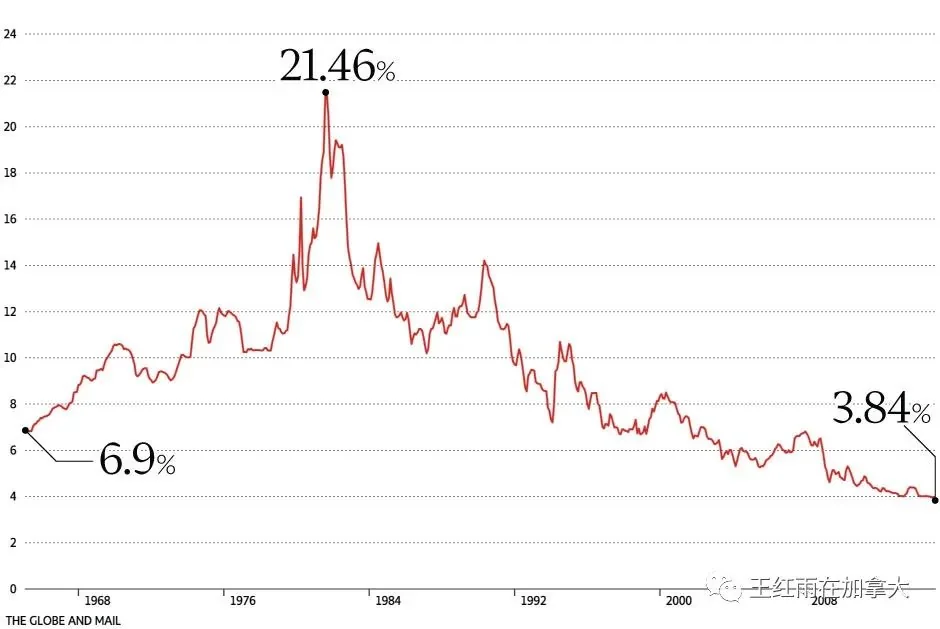
In addition to using the services of the bank to achieve the purpose of making money, the bank itself is a money tree with abundant fruits. However, some people are enemies of the bank, and the consequences are bad; some people regard the bank as their friend, and the consequences are wealth.
During the epidemic, banks provided a mortgage relief program. If the epidemic is severely affected, payments can be suspended for 6 months. There is nothing wrong with using this policy for families who really have repayment difficulties. However, some families feel that this is a good opportunity to make the bank suffer and steal the bank's wool. This idea of treating the bank as an enemy is in sharp contrast to families who strive to overcome all difficulties to repay their mortgage loans and regard the bank as their friend. Families who were friends with the bank did not stop repayments and could increase their mortgage, or lower the original interest rate by mixing and extending the loan period; families who were enemies with the bank did not stop payments, so their mortgages were frozen and the interest rates could not be adjusted. They held the barbell high for 6 months. The most comical result is that when they received the full-year mortgage loan statements for 2020, all families who used the deferred repayment policy found that all the funds they repaid their loans in the other six months of 2020 were charged by the bank as interest. After one year, many families' mortgage balances not only did not decrease, but increased. The income performance of almost all banks in Canada in 2020 is very good, which is related to the receipt of such a large amount of interest. It turns out that the bank's loan contract has already stated that the bank has the right to charge interest first and then the principal.
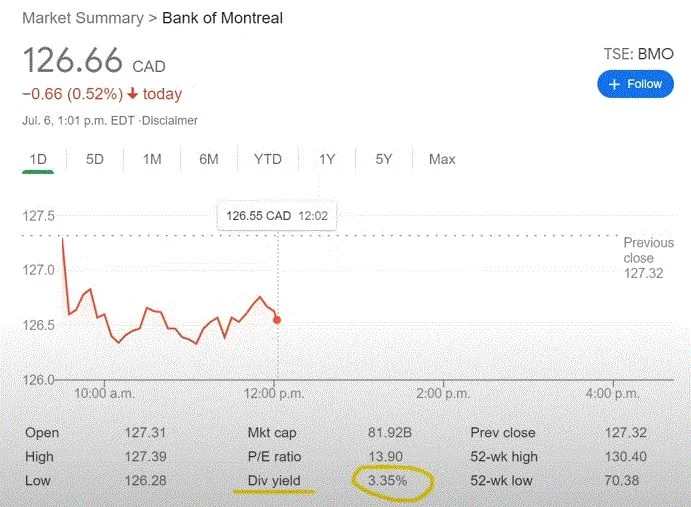
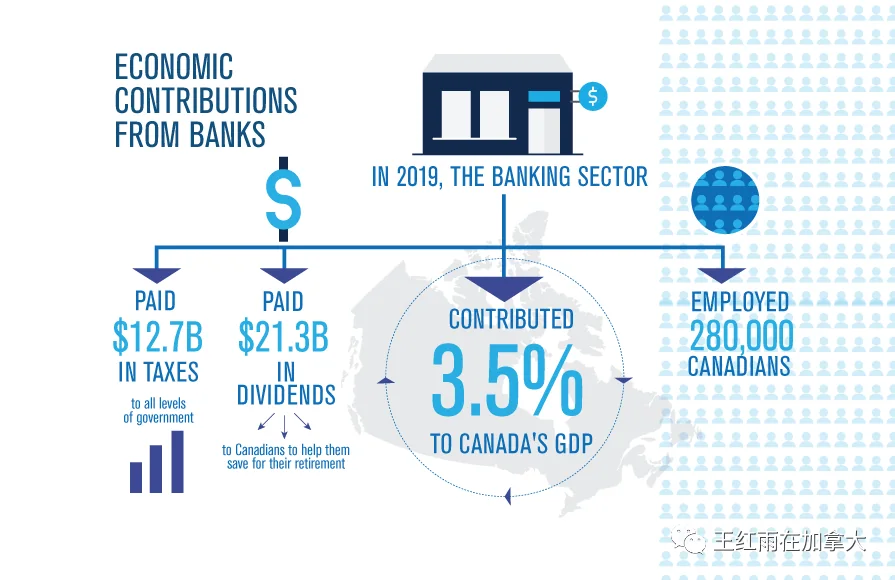
The best way to be a friend of a bank is to buy its shares. Taking July 6 as an example, BMO Bank's dividend was 3.35%, which can basically beat inflation. According to statistics from the Canadian Bankers Association, Canadian commercial banks spend 30 billion on employee wages every year and distribute 21.3 billion in dividends. The amount of dividends is equivalent to 70% of employee wages, which shows that Canadian commercial banks are quite generous to shareholders. Commercial banks use 37% of their net profits for dividends every year, making them well-deserved cash cows. A bank like BMO with a history of more than 200 years has been paying dividends continuously for more than 180 years. It is an old cash cow. If you buy bank stocks, it is equivalent to taking a temporary job in the bank, but you don't have to go to work. Interest spreads account for 44% of banks' main operating income, but during periods of low interest rates, interest spreads will narrow. Therefore, in order to safeguard the interests of shareholders, banks will increase other incomes, such as increasing handling fees. Some people accuse banks of being evil-hearted, but I have also seen people secretly buying bank stocks and becoming friends with the bank through thick and thin. They pay the bank's various handling fees with their left hand and collect the dividends from the bank with their right hand.
After Obama took office, he asked Paul Volcker to help clean up the mess in the financial system. When the 2-meter-tall Volcker appeared in the public eye after the subprime mortgage crisis, the most heartbreaking thing he said was: After the invention of the AMT machine, there was no financial innovation. What he means is that banks and Wall Street are engaging in financial innovation for their own entertainment and have not improved the quality of financial services for ordinary consumers, let alone innovation. But Robert Shiller disagrees. Shiller believes that banks and financial institutions still provide some financial innovation. Structure Notes, the structured notes provided by Canadian commercial banks to high-net-worth clients, is an innovative financial product for ordinary investors. Structured notes are a combination of linked assets and derivatives that strive to achieve capital preservation. Linked assets are highly correlated with the popularity of structured notes. For example, the structured notes launched by banks last week were linked to cruise ship industry stocks, and the structured notes launched this week were linked to banking industry stocks. It is obvious that the latter is more popular. It is reported that structured notes linked to Canadian banking stocks are usually the most popular and sell out quickly once launched. Because Canada's commercial banks are basically operating in an oligopoly state, it is difficult for small banks and foreign banks to survive. ING was once among the top 5 companies in the Fortune 500, but it is actually difficult to survive in Canada. Retirees are very fond of bank stocks, as well as structured notes linked to Canadian banking sector stocks. There is a video on YouTube that specifically introduces structured notes with the Canadian banking industry as the linked asset. "It will be more difficult to find a good job with money in the post-epidemic era (Part 2)" 11 Yue Hongyu Financial Business Breakfast Meeting (Part 2)". To be in the same boat as all Canadian banks, not just one, learn more about this innovative financial product.

Conclusion: The social nature of human beings determines that we must deal with people and institutions in the social hierarchy and establish connections to consolidate our social status and identity. Due to limited energy, everyone has the limitations of their own social relationships, and social relationships that are ignored by you will definitely not be of any help to you, and may even cause harm sometimes. According to my personal observation, Chinese people in Canada have a very weak relationship with commercial banks. After the outbreak, the government's policy banks and commercial banks launched many rescue projects. However, the Chinese missed many opportunities due to a lack of relevant information and care based on personal relationships. From the subprime mortgage crisis 12 years ago to the recent epidemic, when a crisis occurs in all countries, the first industry to be rescued is the banking industry. After the rescue, it is very important who the banks help. In times of crisis, whether banks give a hand or a kick determines the financial security of many small and medium-sized enterprises and families. While understanding the basic services of commercial banks, it is important to establish a bond based on personal relationships with bank staff. Banks are an indirect financing channel, but Canada's direct financing channels are unusual and indirect channels are still the main ones. This is very similar to the situation in China: the stock market is underdeveloped and banks have deep pockets. So there is a situation where those who are near the bank eat meat and those who are far away from the bank eat soup. Getting a low-interest loan from a bank and staying with the bank will definitely help families accumulate wealth faster.
In November, bank reserve ratios will return to pre-epidemic levels, and the government has withdrawn all rescue measures for commercial banks. As banks were rescued during the epidemic, OSFI restricted banks' dividend ratios and stock buybacks, but these restrictions will be lifted accordingly after full normalization in November. The past year has been the best year for Canadian commercial banks. This fall, banks will either increase dividends or buy back shares. In short, they will reward shareholders who have stood by the bank over the past year. Readers who are currently unable to get a loan to buy a house can pay attention to Canadian bank stocks and structured notes linked to Canadian bank stocks. One more friend, one more road. I hope every reader can establish and consolidate relationships with banks in Canada, share the benefits of the banking industry, and become a beneficial friend of the bank rather than a negative one.