Seeing the current low interest rates, many people with high mortgage interest rates feel helpless. From the opening of the interest rate hike channel in July 2017 to February 2020, the interest rates for new or renewed mortgages during this period were relatively high. Even the fixed interest rates of major banks, the highest interest rate can reach 3.64%, and the lowest is more than 2.6%. Some people's loans are still due in 2 or 3 years. It seems they can't bear to do nothing, but how to do it, who to do it, and how to compare the costs and benefits have become thorny issues.
After observing for a while, I found that even though I explicitly and implicitly stated many methods in my previous articles, many people still have difficulty getting out of the predicament. In fact, what 90% of people face is not that they are helpless, but that they don’t know how to get out of the predicament. The 10% of people who are helpless and unable to save themselves include: 1. People who have not obtained loans from banks and financial institutions and have borrowed private loans; 2. People who only care about the interest rate when applying for a loan, and do not care about the lending institution and the terms of the contract. For example, some people have strong borrowing ability, so they choose the lowest interest rate among all financial institutions, and the lowest interest rates are always non-bank financial institutions. The loan terms are naturally inflexible, either because they have no credit line, or they cannot break the contract in advance except when selling a house. Since the interest rate was low at that time, there must be a reason. For 90% of the phenomena that could have saved themselves but could not find a way, I think it is a learned helplessness result. I have found some "high-tech" methods that may be helpful to everyone. I first wrote them down for readers' reference, and finally I will explain what learned helplessness is.

01 Time is money?
The old man on the hundred dollar bill, Benjamin Franklin, left the world with a well-known saying: "Time is money." Time is actually more important than money. How can patients who need emergency treatment get money to buy time? Whose time do you buy, how much does it cost per minute, and how many minutes do you buy? There are many things in this world that are more important than money, including time. I wrote an article "House Slave Turns Back and Sings | How to Pay Off Your mortgage Overnight", which introduced a case where I helped the protagonist invest in a house through additional mortgage/refinance, withdraw cash, and pay off 300,000 dollars for his home in one night. Many people disagree because if the loan taken out from an investment property and mortgage is used to repay the owner's house, the interest cannot be tax deductible. Assuming that the interest rate is 1.9% and remains unchanged for 20 years, it takes 20 years to pay off the 300,000 dollars mortgage, and the interest expense is 60,000 dollars. Using the method I introduced, the protagonist of the story first saved 60,000 dollars in interest, because the tenant will pay the loan in the future, and more importantly, he saved 20 years of time. In your life after paying off your home, you can spend the money you earn on your own without having to use part of it to pay off the mortgage. I paid off my mortgage in November 2017 and started writing this official account in January 2018. The main reason I can persist until now is that I don’t need to spend energy, time and income on my mortgage. When the length of life is limited, the width of life depends on how you use your time. Is there a relationship between mortgage and life? Is it too sensational? Let me tell you a story to help you see the relationship between time and mortgage loans.

A city man, when passing by a certain village, discovered that a farmer was carrying his pigs to eat apples from the tree. After feeding one pig, he picked up the other one to feed. The city people were very surprised, so they walked over and asked the farmer uncle, "Why don't you put the pigs on the ground, knock the apples off the tree, and feed the two pigs at the same time. This will save more time?" The farmer uncle replied blankly, " Is time important to pigs? ". This story is told by Philip Zimbardo at the beginning of "The Paradox of Time", he wants to wake up those who have been holding pigs and feeding apples: Time is not important to pigs, but it is important to people who feed pigs. A loan for a home is a loan, and a loan for an investment property is also a loan. The mortgage is not important, but who will repay the mortgage and how long it will take to pay off the mortgage is.
“Think about the pigs in your life that you need to let go of?” - Philip Zimbardo.

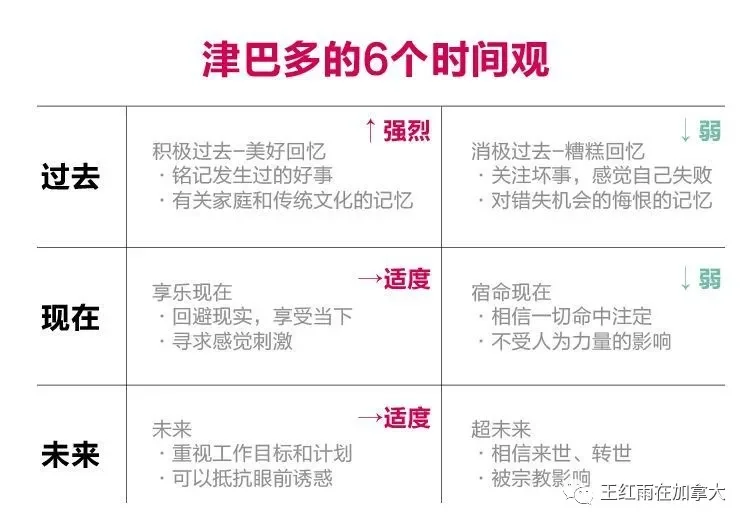
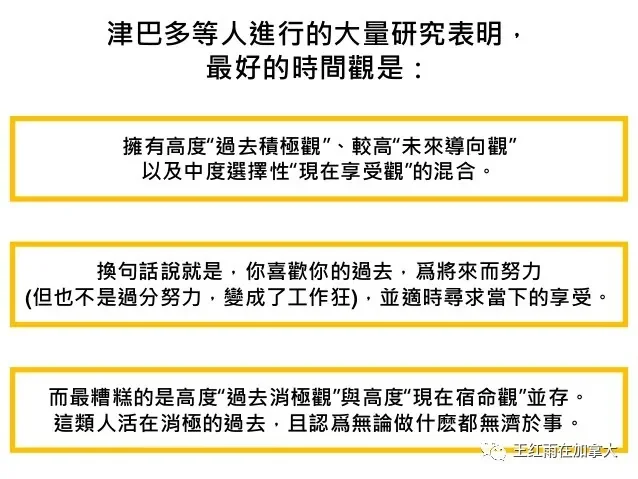
Time is life, not money. Those who want money rather than their lives are desperadoes. Few people who have basic food and clothing problems are desperadoes. The view of time we call time perspective, is the basis of values, world view and outlook on life. People who enjoy immediate pleasure cannot live together with people who have a future view of time. The so-called discord between the three views usually means that they have different views of time. The majority of people are clinging to the pig of mortgage. They think that they should spend their whole life energy and time to repay the mortgage. What's more, poor dads deliberately change houses when they are about to pay off their mortgage, increase the loan, and continue to repay. The reason is that there is no capital gains tax when the home is sold. Your home is sold, where do you live? If you never have the chance to sell your home and save taxes, how can you start talking about it? The famous Canadian investor Gary Slovsky pointedly pointed out in "The Investment Jungle" published when he was 79 years old: Canadians "pay too much attention to tax rather than investment/excessive attention to tax rather than investment." We are witnessing it with our own eyes, More and more people are living a life of hugging pigs and eating apples because they are constantly upgrading to larger homes and trying every means to avoid taxes. The interest of RMB 60,000 on owner-occupied housing can be passed on to the tenants, but some people give up on paying off the owner-occupied loan early because the interest is not tax deductible. Which one is more, the interest of 60,000 dollars or the tax generated? This question is high-tech for many people because they cannot calculate it with their fingers and toes. At the same time, they are also blinded by "paying too much attention to tax avoidance rather than investment."
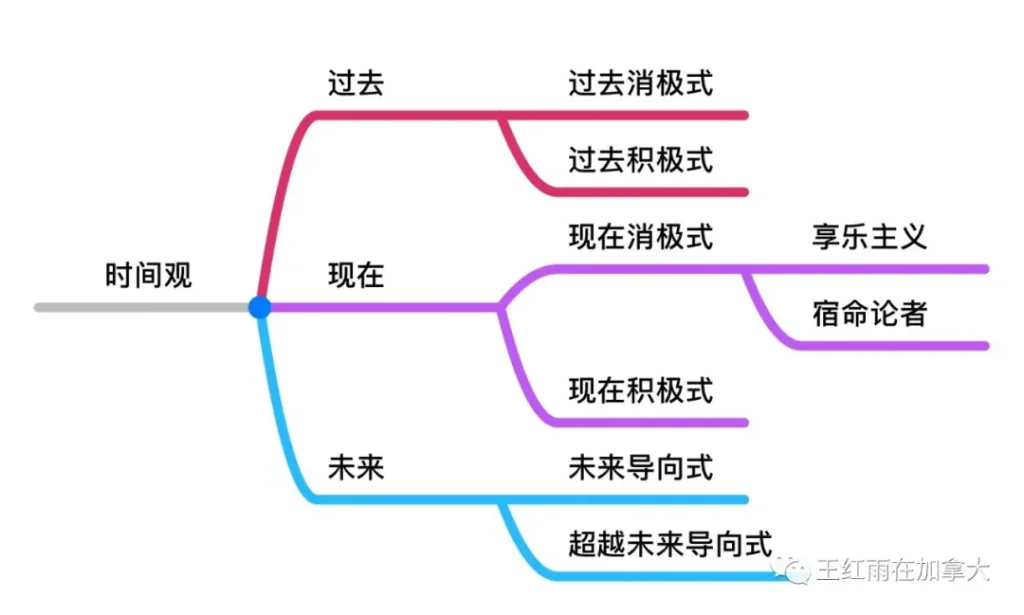
02 Fines for breach of contract are only a roadblock
Since paying off loans, especially owner-occupied loans, is related to the quality of life, then the slowdown in repayment caused by high interest rates becomes a problem. In a low interest rate environment, everyone who originally had high interest rates wants to switch to the current low interest rates. However, Canadian mortgages are different from those in the United States and China. Once the contract is broken, the fines are astonishingly high.
If you default on a floating rate contract, you will only be penalized for 3 months' interest, while for a fixed rate, you need to use the interest rate differential method (IRD interest rate differential) to calculate the penalty and compare it with the 3 months' interest, whichever is higher. Under the spread approach, penalties are particularly high in a falling interest rate environment. I found that most Chinese people have no friends in the bank, and they can’t find anyone to calculate the fine. Every time I ask, different people give different answers, and even the calculation results of the fine are different. Let me tell you a high-tech method, how to use the spread method to calculate fines yourself.
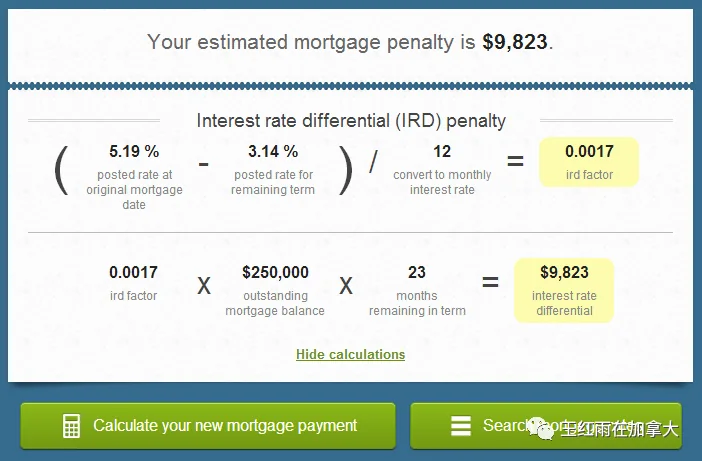
Step 1: Find the mortgage contract and find the post rate/listing interest rate, A%, where the interest rate is stated. Note that it is not the discount rate, but the post interest rate.
The second step is to look at the expiration date of the mortgage contract and calculate that there are N months left to expire.
The third step is to go to the lending institution’s website and find the current post rate/listing interest rate B% of this institution. If N is 55-60 months, B% is the 5-year listing rate; if N is 43-53 months, B% is the 4-year listing rate; if N is 31-42 months, B% is the 3-year listing rate; if N is 19-29 months, B% is the 2-year listing rate; if N is 10-17 months, B% is the 1-year listing rate. N happens to be 54, 42, 30, 18, and B% is the higher of the two listed interest rates. For example, when N=54, the 4-year listing interest rate is 4.2% and the 5-year listing interest rate is 4.79%, then B=4.79%
Step 4: The formula for calculating the fine by IRD = (A% – B%) /12 X Amount X N. For example, when borrowing in 2018, the listed interest rate for a 5-year fixed rate was 5.49%. It is now due in 34 months. The lender's current listed interest rate for a 3-year fixed rate is 3.75%. The loan balance is still 300,000. The IRD penalty is (5.49%-3.75%) / 12 X 300,000 X 34 = 14,790. The fine itself is not the problem, the key lies in how to break this huge fine.
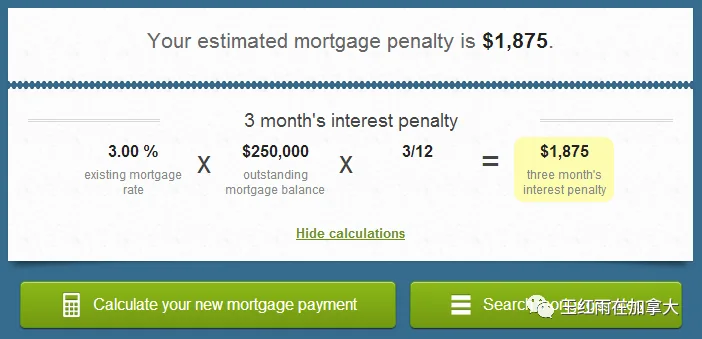
Let me give you a complete set of questions and answers that you should ask when seeking to lower interest rates. The numbers are all fictitious, so don’t bother with calculations:
Question: Hello, my mortgage number in your bank is xxxxx. The balance is more than 500,000, the interest rate is 3.19%, and it is due in 28 months. If I break and RENEW, what is the penalty and what is the new interest rate?
Answer: If you break the contract now, the fine will be 17,000. Among the fixed interest rates, the 3-year interest rate is the lowest at 1.9%, which can save 14,000 dollars in interest expenses in the next three years.
Q: It seems there is no need to lower the interest rate, and I don’t have the cash to pay the fine. Is there any other way?
Answer: Yes. The contract can be renewed to a 3-year fixed interest rate, and the penalty of 17,000 dollars will be converted into the new interest rate, which is 2.6%.
Question: This method seems to be very good. Are there any restrictions?
Answer: Oh, yes, because this 17,000 dollars fine is provided to you in the form of cash back. If you sell the house or transfer it to another bank in the next three years, resulting in another default, the 17,000 dollars exempted today will be returned in proportion to time, and new penalties will also be paid for the new loan.
Q: Okay. Are there any lower interest rates available?
Answer: You can choose to renew the contract now to a 5-year floating interest rate. The mixed interest rate is 2.5%. However, if you default again in the next 5 years, the 17,000 you waived today will be returned in proportion to time, and you will also pay the penalty for this new loan.
Q: I heard that there is a method called BLEND ANDEXTEND which does not charge any penalty but only extends the loan term. Does your bank have this option?
Answer: Yes, what I just mentioned is a type of BLEND ANDEXTEND, that is, using CASH BACK to put the penalty on the account. If the new contract no longer defaults, the penalty will be waived, but the mixed interest rate is between the original high interest rate and the current low interest rate. Once the CASH BACK is defaulted again, the CASH BACK will be returned in proportion to time. Another type of BLEND AND EXTEND does not use CASH BACK, but the mixed interest rate is 3.4%, which is higher than your current interest rate.
Q: Thank you for the detailed answer. I need to consider it carefully before making a decision.
This is a high quality Q&A. The customer is prepared to ask questions, and the person who answers has sufficient work experience and patience. Whether you can find good customer service to answer your questions depends on your character. From what I understand and summarize so far, there are four main ways to break high interest rates.
The first type, BREAK AND RENEW , that is, breaking the contract in advance and renewing the contract , just paid the fine and renewed the contract. If the fine is less than 5,000, you can incorporate the fine into the principal without having to pay out of your own pocket. If the fine is 15,000 dollars and you don’t have 10,000 dollars in cash, and you can’t pay the fine even if you want to, you have to either speed up the repayment and reduce the principal, or use the second method.
The second type, BLEND AND EXTENDEARLY RENEW , make a hybrid extended contract renewal, For example, if there are still 2 and a half years left to expire, you can renew a 3-year contract now; if there are 3 years left to expire, renew a 4-year contract, that is, extend the original loan maturity date and obtain a new interest rate. This new interest rate is neither the previous high interest rate nor the current low interest rate, but a mixed interest rate. Some banks charge fines for this practice, while others do not. Banks that charge fines may use CASHBACK Accounts are posted in the form. Borrowers are in luck for banks that mix and extend options without penalty. This is the most hard-core high-tech part of this article.
The third method, if there is HELOC , you can withdraw money from the line to accelerate the repayment of the principal with high interest rates, and then turn this withdrawal into a low-interest loan.
The fourth method is for friends who have a lot of real estate, find an investment house with the lowest penalty as an additional mortgage. Mortgage default penalties on investment properties are tax deductible. Withdraw cash from the property to accelerate the repayment of other high-interest loans, or to strengthen cash reserves and extend the repayment period back to 30 years to improve cash flow. Multi-house investors can search for treasures in "Secrets to Save Money on mortgages" to learn how to optimize their investments and mortgages.
Finally, let me tell you a little tip. It is very important and may save you thousands or tens of thousands of dollars in fines immediately. In the IRD calculation method, A% is the interest rate at the time of the loan and cannot be changed. The amount of the penalty depends on the level of B%. B% The lower the price, the greater the fine.. On November 1, 2020, when you open the websites of BMO and CIBC, you will find that the 1-year and 2-year fixed interest rates of the two banks are different. BMO's 1-year fixed interest rate is 3.09%, and the 2-year fixed interest rate is 3.29%; CIBC's 1-year fixed interest rate is 3.19%, and the 2-year fixed interest rate is 2.89%. Suppose you have a loan that is due in 20 months. If it is a BMO loan, you have to break the contract as soon as possible, otherwise the B% will be even lower after 3 months. If it is a CIBC loan, you have to delay breaking the contract for 3 months because the B% will be higher after 3 months.
03 How come we have learned helplessness?
Among the inquiries I received, the people who were in the worst situation were those who had chosen non-bank financial institutions for loans. Because banks have various services/services, they cannot compete with non-bank financial institutions in terms of interest rates. The source of funds for most non-bank financial institutions’ mortgage loans comes from selling mortgages and securitizing the mortgages, that is, making a loan, selling a loan, and then outsourcing the loan service to an 800 number. If the borrower has something to do, please call a call center somewhere in the world. Like the high-quality Q&A above, you can't do anything with the 800 number. No matter how many articles I write, I can't help you. In order to simplify this kind of service, the loan contract is made simple and crude. There is no customer service that can be met, no BLEND AND EXTEND option, and no HELOC option. It is just like if you buy a cheap air ticket, you will enjoy the cheap service. It is difficult to change something midway. Families with no way to deal with the 3.6% interest rate were basically those who were most enthusiastic about shopping interest rates back then.
Will people who choose a major bank find help? Judging from the various phone calls I received, many Chinese people have no friends in banks. They think that once they handle a mortgage loan, they will never have to deal with it again. It is a waste of time and experience to get to know and make friends with bank staff. Interpersonal relationships belong to social capital. People who lack social capital have difficulty moving forward and encounter obstacles everywhere. Even if I taught you how to calculate IRD fines, it would be of no use. Once you know the fine, you also need to know the new interest rate after breaking the contract to calculate the gain and loss. Who can help you calculate it? Now that you know the pros and cons, who will help you operate it? These series of problems cause learned helplessness: 80% of people stop trying to get out of trouble after hitting the wall again and again.
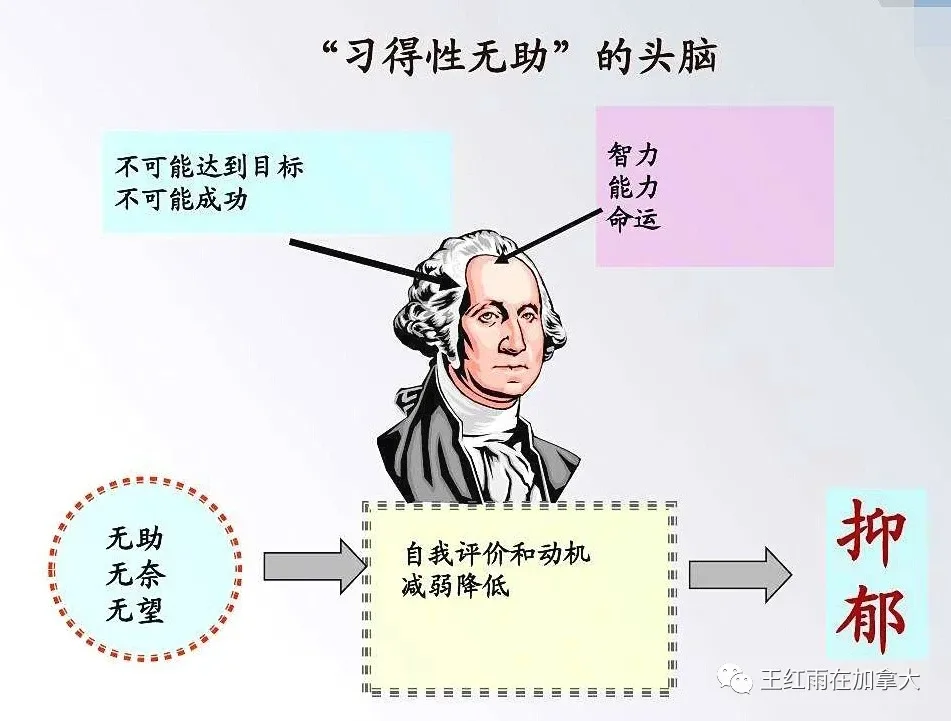
"'Learned helplessness' was proposed by the American psychologist Seligman in 1967 when he was studying animals. He conducted a classic experiment with dogs. At first, the dogs were locked in a cage. As soon as the buzzer sounded, they were given electric shocks. The dogs could not escape the electric shocks in the cages. Many experiments Finally, when the buzzer sounds, the cage door is opened before the electric shock is given. At this time, the dog not only does not escape, but falls to the ground and begins to moan and tremble before the electric shock occurs. It could have actively escaped but waited desperately for the pain to come. This is learned helplessness. "-Baidu Encyclopedia.

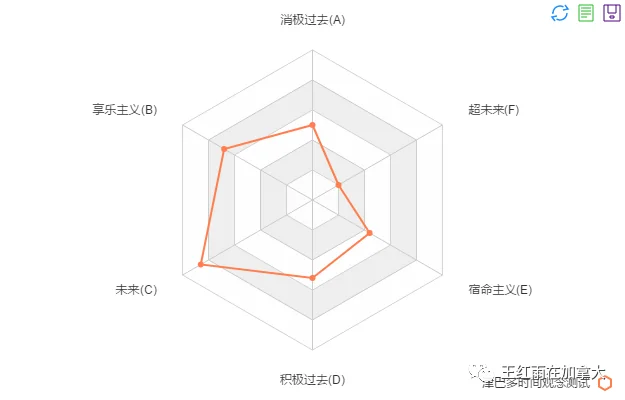
After many attempts to change interest rates and repeated failures, people develop a state of learned helplessness. I don’t know how to do math, and I can’t find anyone willing to take the time to help. It would be weird if I didn’t fail. I recently read Zimbardo's "The Time Paradox" and was deeply inspired. I also read Seligman's "Authentic Happiness" recommended by Zimbardo. It was Seligman who discovered learned helplessness and had his own views on the connection between time and learned helplessness: People who do not cherish time do not cherish life and do not cherish life. People who cherish life are not grateful to those who have helped them. People who are not grateful have no friends. People without friends often fall into learned helplessness. This helplessness leads to the inability to change the status quo. The pessimism about the status quo leads to the waste and wasting of time, drifting away from true happiness.
How come we have learned helplessness? Look at how you usually behave, whether you use long-term interpersonal relationships to consider the pros and cons, or whether you use immediate small gains to make trade-offs; treat the people who serve you with respect as professionals, or treat them as disposable tableware. The establishment of social capital requires time, small losses, gratitude, and mutual respect. People who lack social capital are always in a state of learned helplessness.
Conclusion:
How many steps does it take to put an elephant in the refrigerator? It doesn’t matter how many steps it takes, what matters is that you have a big enough refrigerator.
How many steps do you need to lower your mortgage interest rate? It doesn’t matter how many steps it takes. What matters is whether you have accumulated enough character and can find people to help you.



Time doesn’t matter to mortgages, does time matter to you? The high interest rates on mortgages just can't be lowered, which shows that you are already in a state of learned helplessness, because there is a solution to this problem, but you just can't find it. After hitting the wall many times, it becomes unsolvable. For those who have no solution at all, think about why they chose such a loan with no solution at that time. People who can read this article will not think that mortgages are a trivial matter, and will also reflect on their own time perspective to varying degrees. I hope this article can not only help everyone lower their interest rates, but also inspire some thoughts about life. If you think this article is valuable, please forward it to your friends so that you can have more friends in Canada. Start accumulating your own social capital and get rid of learned helplessness today.