
After the Bank of Canada cut interest rates on October 29, the central bank interest rate dropped to 2.25%, the commercial bank's preferential interest rate P dropped to 4.45%, and the mortgage interest rate returned to about 4%. The Bank of Canada's interest rate cuts in September and October were based on the assumption that Canada's economy was relatively weak, without data support. Therefore, the possibility of further interest rate cuts has been greatly reduced.
The mortgage interest rate of 4% is a watershed. The rental cost of a renting family is already very close to the sum of interest, property taxes and management fees incurred by borrowing money to purchase a house. Therefore, some renting families have started planning to buy a house. For real estate investors, if they buy a house with cash, the rental return rate is around 4%. Therefore, when the mortgage interest rate is 4%, real estate investors can look for investment opportunities in the market with a rental return rate higher than 4% and a loan interest rate lower than 4%.
Families that are already burdened with mortgage debt need to find ways to lower the interest rate on their existing debt to around 4% if the existing loan interest rate is higher than 4%. Some families have unfinished property bombs and do not know when the property will be handed over. Therefore, they need to lower the monthly payment of their existing debts to increase their borrowing capacity for the pre-construction property. They even need to raise funds in advance to prepare for the large down payment that may be required when the property is delivered.
This article will go from easy to difficult and give you some suggestions to lower your existing mortgage interest rates and monthly payments by yourself without relying on the central bank to cut interest rates.
01 Early contract renewal, floating to fixed, painless interest rate reduction
Both fixed and floating interest rates have been relatively high in the past three years. The mortgage interest rates of some families are still above 5% today, and there is still a certain amount of time before the lease is due to be renewed. The most effective measure to reduce interest rates is to renew the contract in advance. Open your own online banking, check the interest rate and maturity date of the existing loan, and then check the lending bank's website for early renewal policy. For example, the existing loan has a fixed interest rate of 5.5%, the maturity date is June 20, 2026, and the lending bank is BMO. If you enter What's the date 180 days prior to June 20 2026? in the GOOGLE search bar, the result will be "Monday, December 22, 2025". At this time, you can record the date that can be renewed in advance in the calendar and submit it to BMO 20 days in advance. The bank applies for early renewal, that is, on December 2, you can consult BMO Bank for the renewal interest rate and submit an application, and the new loan interest rate will start on December 20. All BMO Bank loans, whether fixed or floating, with or without a line of credit, can be renewed 180 days in advance. The purpose of early renewal is to terminate the contract with a high interest rate as soon as possible and make the contract with a low interest rate effective as soon as possible. There is no need to verify income for renewal, which is the simplest and fastest way to reduce interest rates painlessly. In practice, many borrowers miss the earliest early renewal time, which is a pity.
The floating interest rate can be converted to a fixed interest rate without penalty during the loan contract period. The new loan contract period, plus the time that has passed, shall not be shorter than the original loan contract period. For example, the existing floating interest rate is P minus 0.1%, and the current P is 4.45%. The loan contract was signed on August 1, 2023, and the expiration date is August 1, 2028. On November 11, 2025, if it is converted to a fixed interest rate of more than 3 years, there will be no penalty; if it is converted to a fixed interest rate of 2 years or 1 year, or to a floating interest rate with a larger discount, a penalty of three months' interest will be paid.
02 Give priority to accelerating the repayment of owner-occupied mortgages
Whether to accelerate repayment depends not only on the interest rate, but the most important factor is whether the property is owner-occupied or rented. If you are able, you should accelerate your home mortgage repayments at any time, regardless of whether the interest rate on the loan is high or low. Because of the low interest rates for home ownership, many families are reluctant to accelerate repayments and use cash for financial investment or deposit into RRSP. Don’t forget that loans have an expiration date, and no matter how low the interest rate is, there will be an expiration date. Interest and dividends on financial investments are taxable, unless the investment is in an RRSP or in a TFSA account, and interest payments saved by accelerating the repayment of a home mortgage loan are not taxable. For example, the fixed-term savings GIC deposit interest rate is 2.6%, and the mortgage interest rate is 1.9%. If you have 10,000 dollars in cash, should this cash be used to accelerate repayment, or to buy a time deposit certificate? Calculation is needed here. If the personal marginal tax rate is 30%, investing in a time deposit with an interest rate of 2.6%, the after-tax rate of return is only 1.82%, and the rate of return used to repay the mortgage is 1.9% after tax. In this case, it should obviously be used to accelerate the repayment of the home mortgage loan.
If you have multiple houses and multiple mortgage loans, the self-service debt restructuring method is to increase the balance of the low-interest rate loan while reducing the balance of the high-interest rate loan. For example, if you have 10,000 dollars in cash, the fixed interest rate for mortgages is 4.5%, and the floating interest rate for investment homes is 3.7%. The investment mortgage has been repaid in advance, and there is a limit of 10,000 dollars in BMO's mortgage cash account. At this time, you can use the 10,000 cash in hand to accelerate the repayment of the home mortgage loan, and then withdraw the loan from the mortgage cash account Withdraw 10,000 dollars from the loan and make it into a time deposit GIC. The cash in hand remains unchanged, the balance of the self-mortgage with an interest rate of 4.5% decreases by 10,000 dollars, and the balance of the investment mortgage with an interest rate of 3.7% increases by 10,000 dollars.
03 Use credit lines, adjust interest rates, and optimize monthly payments and cash flow
Now, many people’s families are strapped for cash and therefore cannot afford to speed up their repayments. The actual situation is that multi-suite investors can move between different loans, increase the balance of low-interest loans and reduce the balance of high-interest loans, thereby reducing borrowing costs and improving cash flow by using the policies and tools that come with the loan product without consuming cash.
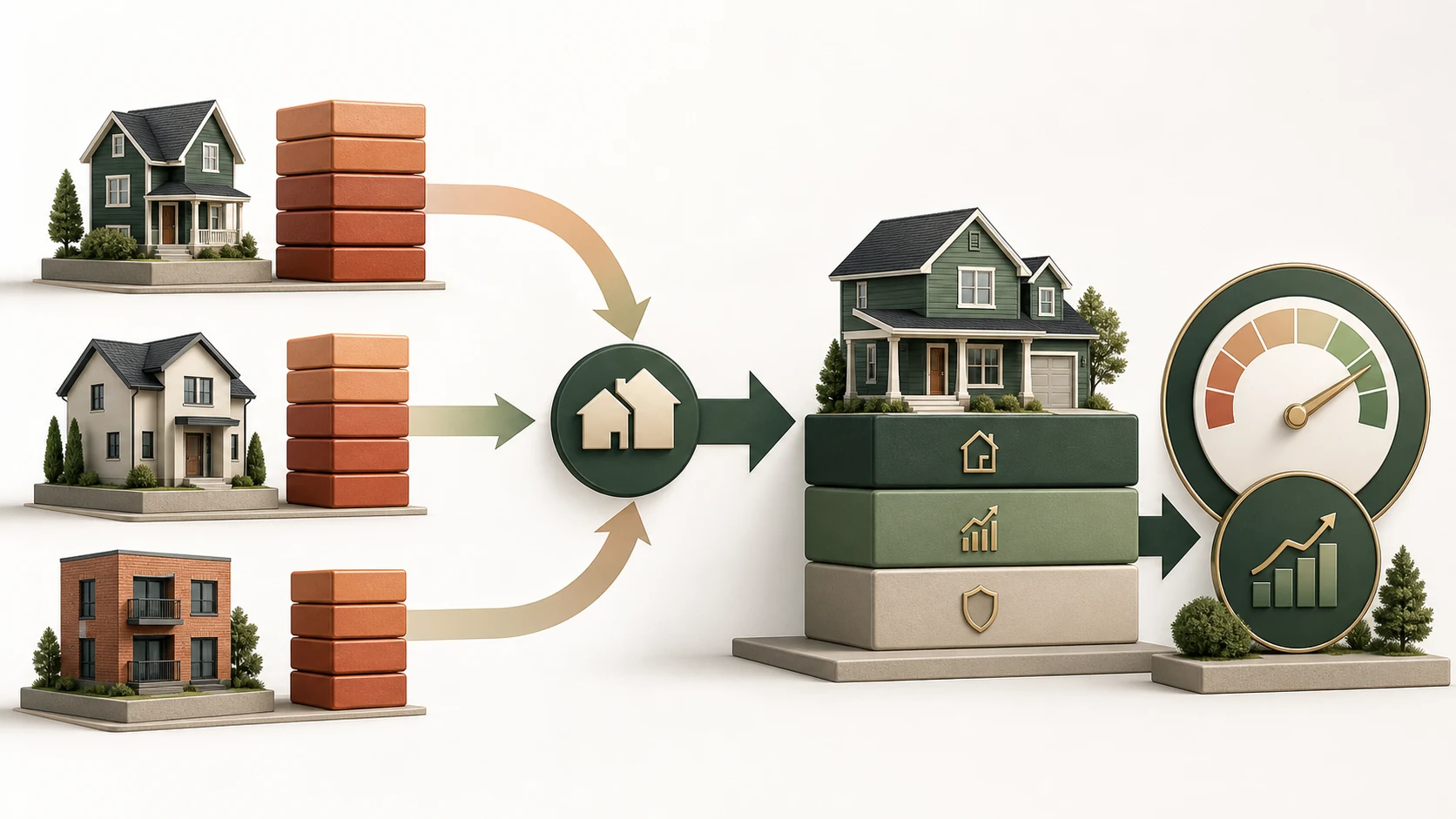
Multi-home investors have multiple mortgages, some of which may have a HELOC line of credit. At this time, there is an efficient weapon for moving interest rates. The first step is to check how much available line of credit is available; the second step is to withdraw cash from the available line to repay the investment mortgage with an interest rate higher than 4%; the third step is to convert the withdrawn cash into an installment loan installation at the current mortgage loan interest rate.
For example, there are four investment houses ABC and D. There is an available credit of 150,000 for house A. With 150,000 dollars in cash, we accelerate the repayment of the mortgage loan with an interest rate of 5.5% for investment house B by 50,000 dollars.
The amount of accelerated repayment for which loan depends on three factors: 1. The amount of accelerated repayment allowed for this loan within the year; 2. Prioritize the repayment of loans with high interest rates; 3. The cash flow of which property is urgently needed to be improved.
For many banks, such as TD and BMO, the deadline for exercising the annual prepayment limit is December 31 of each year. For example, before December 31, 2025, BMO loans, except for smart products, can repay 20% of the initial principal in advance without penalty. If this right is not exercised after expiration, it will not be carried forward to the next year. If you have a high-interest loan, you can make full use of the early repayment limit to accelerate the repayment of the high-interest mortgage loan.
According to the above example, if 150,000 cash can be withdrawn from the credit line HELOC of property A, the interest rate of the loan on property C is the highest, 6.3%, and the annual accelerated repayment amount is 70,000. If the power to accelerate repayment is calculated based on the calendar year, then the most efficient accelerated repayment plan is: 2025 On a certain day in December 2020, 150,000 dollars was withdrawn from the credit line of House A and converted into an installation at the current interest rate. The loan balance of House C was accelerated by 70,000 dollars and the balance of the loan balance of House B was accelerated by 10,000 dollars. By January 2026, the accelerated repayment limit of the new year was used to accelerate the repayment of the loan balance of House C with another 70,000 dollars. The loan balance of house C with an interest rate of 6.3% decreased by 140,000 dollars, the loan balance of house B with an interest rate of 5.5% decreased by 10,000 dollars, and the loan balance of house A increased by 150,000 dollars. Most banks, when converting HELOC withdrawals to installation, allow a 30-year repayment period. After the loan balances of House C and House B are reduced, you can apply to the bank to reduce the monthly payment. Through the above operations, the overall household monthly payment after reorganization will be reduced, thereby improving the household's cash flow.
You can follow the above logic, re-examine your debt situation, and reorganize debt yourself based on the available credit limit, early repayment limit, interest rate level, and cash flow preference. By doing this kind of restructuring at the end of the year, you can make full use of the rules on early repayment limits and move interest rates and loan balances more efficiently. My own clients can call me and I will help you plan.
04 Redo loan
People often ask me whether they should switch banks when the loan comes due. In my opinion, if it is just for shopping interest rate, there is no need to transfer to a bank when the loan matures, unless there are other needs. For example, extending the repayment period of the original bank loan, cashing out the property rights, converting the original loan without a credit limit into a loan with a credit limit, transferring the loan from a loan shark institution to a bank, etc.
Extending the mortgage loan repayment period can effectively reduce monthly payments and improve cash flow. Most banks do not extend the repayment period when renewing the contract. For example, the current repayment period is 22 years. If you renew with the original bank, the maximum repayment period is 22 years. If you switch to another bank, the repayment period can be extended back to 30 years. When investing in real estate, it is necessary to lengthen the repayment period before retirement, because the pension after retirement may no longer be able to support the income requirements for redoing the loan. Some people think that after retirement, it is enough to repay the investment mortgage as soon as possible, and there is no need to redo the loan before retirement. For families with relatively generous pensions, it is necessary to extend the repayment period before retirement, because the income after retirement is still taxable income, and it is necessary for the mortgage interest to be used for tax deduction. Investment houses without mortgage loans will generate higher net rental income and increase the tax burden. In addition, families with unfinished properties that have not yet been settled will face a stress test when applying for loans when the uncompleted properties are delivered. Therefore, if the existing property loan expires, it is very necessary to redo the loan, extend the loan repayment period back to 30 years, reduce the monthly payment, and prepare to ensure that the loan is obtained when the uncompleted properties are delivered.
After entering 2026, high-priced pre-construction properties will usher in a peak delivery period. The prices of uncompleted properties purchased between 2020 and 2022 are very high, but banks provide loans based on the market price at the time of settlement. Therefore, many buyers of high-priced pre-construction properties need to prepare sufficient cash reserves. By refinancing your existing mortgage loan, you can draw down as much cash as possible in your home equity as a backup. Developers of high-priced pre-construction properties have a strong desire to survive. Buyers who are looking forward to the developer's bankruptcy and the return of their deposits are best prepared to hand over their properties on time instead of praying to welcome the gray rhinoceros.
From the above example, we can see that having a credit line HELOC on an investment house can facilitate debt restructuring in the future. Therefore, if the loan that expires does not originally have a credit line, you can take advantage of the opportunity of transferring the loan to a bank when it expires and apply for a mortgage with a credit line from the new bank.
Conclusion
Debt management is an important part of financial intelligence. Doing it yourself, lowering loan interest rates and improving cash flow is an essential skill for real estate investors. This article is not long, but it is valuable. Readers who reward this article can leave your specific questions and I will try my best to reply.