I am often asked a question, "Has the loan policy changed recently?" It's like a way of saying hello, "HI, long time no see, how are you doing?". Loan policies don’t change often, and even if they do, everyone is affected. The loan policy will not change according to a certain person's needs. Some people actually hope that the loan policy will be changed so that they can get a loan, instead of trying to make themselves meet the loan conditions. People who are concerned about changes in loan policies are simply worrying. According to the existing standards, improving their own situation is what they should be worrying about.
"I didn't pay attention to the cash flow issue when I bought an investment house before. The negative cash flow was too big, and now I can't apply for a loan." This seems to be a mistake in self-reflection. If you have three investment houses, each with positive cash flow, and have no job income except rental income, you will not be able to apply for a loan for the fourth investment house. The cash flow of the existing investment house does not play a decisive role in whether the next investment house can be approved. Anyone who cares about the cash flow of an investment property is simply worrying. Even if there are three investment houses without loans, positive cash flow, and no income from work, you still cannot apply for a loan for the fourth investment house. On the contrary, the three existing investment houses all have negative cash flow. As long as the owner-housing debt is low enough and the working income is high enough, a loan for the fourth investment house can still be approved.
So, when it comes to real estate investment, what should you worry about and what shouldn’t you worry about?
01 The mortgage policy is based on the college entrance examination score. Is it a good thing if it is lowered?
The people who are most concerned about the mortgage policy are those who cannot apply for a mortgage loan under the current policy. In fact, whether a person can apply for a mortgage loan can be determined by asking two questions: What is the annual income? What is the monthly payment for owner-occupied housing and other consumer debt? When people call to inquire about loans, the more they fail to apply, the more they hold the phone and refuse to put it down, always hoping to find out "other ways."
The mortgage policy is like the score line for the college entrance examination. Unless the decision is made to expand enrollment, the score line will not be lowered. The result of the expansion of enrollment is that cats and dogs have all gone to college. Of course, there is no distinction between education and education. The more people receive education, the better, but diplomas are worthless. The same goes for mortgage policies. Once liberalized, housing prices will plummet and become even more unaffordable. The charm of real estate investment is that, unlike stocks, there is a threshold and people with low income and low financial intelligence cannot get in. Therefore, the real estate market is more rational than the stock market.
I checked the history of changes in investment mortgage policies in recent years: starting in 2010, the down payment for investment housing was at least 20%, which has not changed for 10 years; starting in 2012, the maximum repayment period for investment housing was 30 years, which has been 8 years; the latest mortgage regulatory policy B20 was implemented in January 2018. Since then, there has been no new policy for investment housing.
Mortgage loan interest rates are the lowest among all consumer loans , it can be said that it is a benefit provided to people with high tax returns, so the threshold is relatively high. Letting those who can get loans get rich first is a unique Canadian fairness and justice. People with low incomes can receive government benefits and relief, but banks are not charities and must ensure that the money they lend can be recovered.
Relaxing mortgage policies is not a good thing for families who work hard and pay taxes truthfully. People who can get a loan always ask if there are any changes in the mortgage policy, which is sheer nonsense; people who can't get a loan don't always ask if the college entrance examination score line for the mortgage policy has been lowered, because banks and the government want to maintain the reputation of real estate investment universities and have no intention of expanding enrollment.
02 Cash flow is a false proposition
Lao Liu bought 4 houses, ABCD, house A is his own residence, and the others are investments. Every month, the monthly loan payment for House A is 2,500, House B has a negative cash flow of 400, House C has a negative cash flow of 450, House D has a negative cash flow of 500, and Lao Liu’s total monthly negative cash flow is 3,850. Taking advantage of the low interest rates, Lao Liu decided to remortgage the unexpired BCD into a low interest rate. At the same time, he extended the repayment period back to 30 years to reduce the monthly payment as much as possible. After completing the remortgage, the cash he took out from three investment houses was used to repay the mortgage, reducing the monthly payment of home A to 1 500, the monthly negative cash flow is 500 after B's additional mortgage, the monthly negative cash flow after C's additional mortgage is 550, and the monthly negative cash flow after D's additional mortgage is 600. After Lao Liu added another mortgage, the monthly negative cash flow became 3150, successfully leaving more of the owner-occupied housing debt to the tenants to pay. Those who insist on the negative cash flow problem of investment properties but believe that the mortgage should be repaid by themselves are seriously lacking in financial intelligence. Many people are rusty on the issue of negative cash flow, and their mental accounting is set wrong. If you consider cash flow, the most important thing to consider is the monthly payment for your home, because, The monthly payment for the owner-occupied house is the largest negative cash flow for the family. However, negative cash flow from investment properties is beneficial and harmless.
There are three benefits of negative cash flow for investment properties: 1. Low down payment, that is, the down payment is also borrowed, and the interest rate enjoys the mortgage loan interest rate. The monthly negative cash flow is the installment amount of the down payment; 2. High leverage; 3. Low net rental income, tax saving. If you make a 35% down payment, you can achieve positive cash flow, but the bank only needs to approve your 20% down payment. You have two options: 1. 20% down payment with negative monthly cash flow; 2. 35% down payment with positive cash flow. Which one do you choose? The advantage of choosing 1 is: you save 15% down payment, or understand that the 15% down payment is borrowed, not your own deposit, and the interest rate is the mortgage loan interest rate; 5 times leverage means that the house price increases by 5%, and your investment return is 25%; the net rental income should be Tax income and interest expenses can reduce net rental income. The higher the down payment, the higher the interest expense and the lower the net rent. A low down payment can save taxes; most importantly, by saving 15% of the down payment and another 5% of the down payment, you can buy an additional investment house.

Negative cash flow is essentially the installment payment of the down payment, which can also be regarded as a fixed investment in real estate. The biggest benefit for investors at the moment is tax savings.
It makes no sense to use positive cash flow to measure the quality of real estate investment. The higher the down payment ratio, the better the positive cash flow. When the down payment is 100%, the positive cash flow is the highest. For the same property, I pay 20% down and you pay 100%, so your investment is better than mine? I used a 20% down payment and a monthly negative cash balance of 400 dollars. I used my own off-site income to pay for it, which is a fixed investment in real estate, or an installment payment of the down payment. Because I don’t need cash flow now, but I will need cash flow after retirement, so now I ask the tenant to pay down the loan balance day and night. If I pursue current cash flow, the down payment will have to be increased to 35%, the net income will also increase due to low interest expenses, and the current tax payable will be high. This is not what I want.
For those who are worried about the cash flow of investment properties, it is better to worry about the loan for your own home and see if the monthly payment is too high and the bank will no longer approve your next loan. 99% The reason is that the monthly payment of your mortgage is too high, not that the cash flow of the investment property is negative.
03 The government wants to freeze rent increases next year, what should we do?
Rental control Rental control is a method used by many large cities to control excessive rent increases. In "Principles of Economics", Mankiw listed three examples of government policies that backfired, and rent control ranked first. That is, the more you try to control rents, the faster rents will rise.
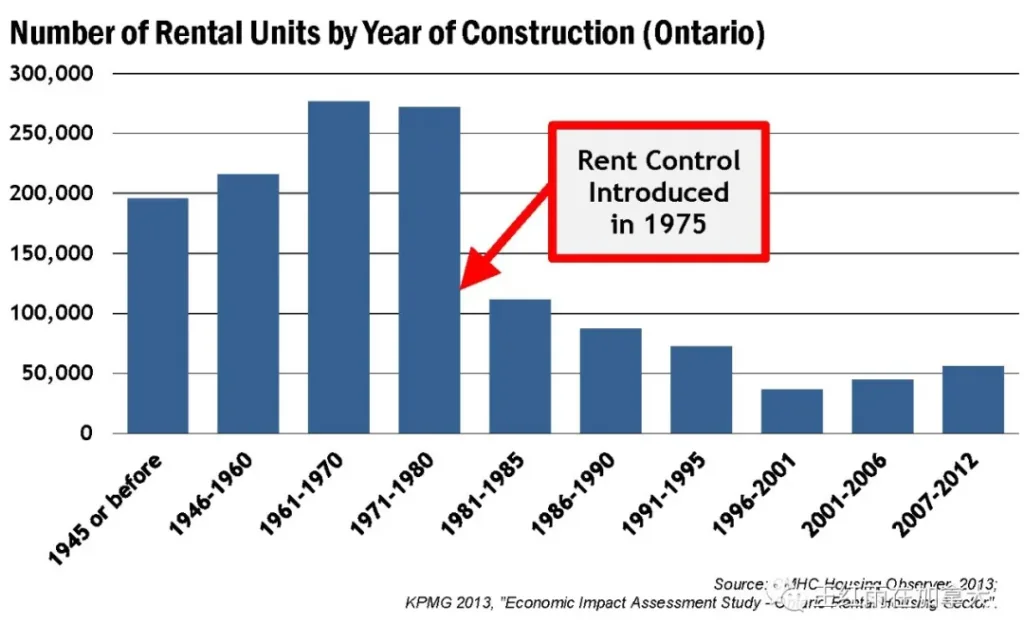
Ontario began implementing rent control in 1975. Builders have since slashed construction of apartment buildings dedicated to rentals. Big capital has since withdrawn from the rental market. It is precisely because of the withdrawal of these large capitals that retail investors have opportunities.Just imagine, if there is no rent control, developers build CONDOs not for sale, but for rent. The number of units available for rent will increase significantly, and the increase in supply will reduce rents, resulting in a decrease in apartment prices. Aren’t we, the retail investors in real estate, going to be squeezed into the stock market like Americans, playing a zero-sum game with people with poor financial intelligence and high emotional swings? Thank you for the rent control policy. Tighten it from time to time to sound the alarm to those big capitals: don’t enter the rental market easily. Currently, properties built in Ontario after November 2018 are not subject to rent control, and other properties are subject to rent control. If the Ontario government fully liberalizes rent control, it will be a problem. Big capital will swarm in and drive small investors like us out of the market.
Don’t worry about next year’s rent control issues and the conflicts between tenants and landlords. Renting a house is a business that needs to be run. Rent control is like a franchise, protecting retail investors from the impact of big capital. Cherish this policy that may seem stupid, but it really helps small landlords a lot.
04 Will there be large-scale property auctions after the mortgage deferment policy ends?
A friend told me that residents in some communities received flyers. The general meaning is that if you have difficulty repaying your mortgage after the six-month repayment delay allowed by the bank and want to sell your house, you can contact the person on the flyer. I think these people who post small advertisements think too much. Real estate in Canada is not easily auctioned off.
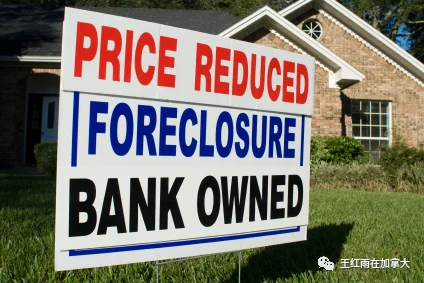
Auction, foreclosure required, Foreclosure/ Foreclosure means that the homeowner has lost the right to redeem the property due to default on the bank account, and the property owner has changed the name of the bank. If Canadian banks want to recover the foreclosure rights, they must go through legal procedures. Only with a court judgment can they recover the foreclosure rights and then auction them. Many states in the United States do not require a court judgment and can foreclose as long as the borrower defaults. "House Slaves" describes the vicious case of American banks auctioning off borrowers' properties based on forged evidence after the subprime mortgage crisis. The phenomenon of large-scale real estate auctions in the United States is caused by a specific period and the unique legal system of the United States. Predatory lending has never happened in Canada, that is, when you lend money, you know that the borrower will not repay the loan, and then wait for you to default and sell your house.
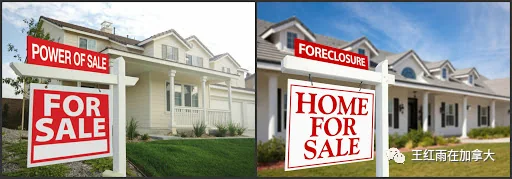
In Ontario, if a borrower fails to pay overdue payments, although the bank will not immediately obtain the right to foreclose on the property, it can sell the property. This procedure is called powerof sale , that is, if the property is sold before the bank obtains foreclosure, the property is still in the name of the borrower, not the bank,The borrower can terminate the sale process by repaying the arrears and paying the bank's legal fees. For a property that enters power of sale, even if the bank has successfully sold the property, the borrower will have the opportunity to terminate the sale transaction as long as the title delivery is not completed. For properties sold through power of sale, the bank needs to return the balance to the borrower after deducting the principal, interest and legal fees in arrears. It is very difficult to close a deal on a property that has entered the power of sale procedure. First, the seller will not cooperate and the seller will fight until the last minute to prevent the sale. Second, the bank must list the property for sale at a fair market price, otherwise the borrower will take it to court, and the price is not cheap. I have seen people claiming to be "experts on bank auction houses". I feel very sorry for such experts. They specialize in finding and trading this kind of real estate. Can they support themselves? The book "House Slaves" describes how homeowners who default on their loans fight to avoid being evicted from their houses. It is a desperate struggle to maintain dignity and survival. It is not easy to buy a cheap bank auction house. As for the rumors that there will be large-scale real estate auctions in Canada, they are purely nonsense.
For more popular knowledge about foreclosure and power of sale, you can search for an article to learn more about Ontario foreclosure vs Ontario power of sale – What are the differences?
05 If new immigrants and international students can't get in, will housing prices go down?
The number of newly built properties is limited, so housing prices are supported by population inflows being greater than the number of newly built houses. The epidemic has disrupted international flights, and the rise in housing prices should have slowed down. However, locals’ demand for home replacement has taken over the responsibility of driving housing prices. One thing that everyone is full of doubts about recently is: Where does the money come from to drive up housing prices?
The current round of price rebound in the real estate market after the epidemic is entirely driven by the demand of local residents for house replacement. The source of funds is not overseas remittances or local deposits, but additional mortgages on existing properties. If you live in House A, add a mortgage on House A, take out the cash as a down payment to buy House B as your own home, you will have money. Because House A was not sold, House B was bought again, and the market supply was reduced, so house prices rose. This is the power of the capitalist market economy, which allows people who can borrow money to buy more houses and buy bigger houses.
A good person will draw a K-line chart when analyzing the market for prospective buyers, and analyze the price and trading volume together, hoping to deduce the trend of the next month from last month's trading situation. In stock investment, no one makes money by looking at the K-line. This kind of witchcraft has long been seen through by stock market investors.

I have never shared my experience buying an investment property because I have nothing to share. As long as the down payment is ready and the loan is approved, go ahead and buy it. There is no need to carefully choose which type of property, because the prices of CONDO, TH, semi, and house are rising in turn. I have bought at market lows and at market highs, but in the long run, there is no difference. Whether it’s stocks or real estate, no one makes money by trading, they all make money by holding good assets for a long time. Some people have the illusion that they are Wall Street traders and can make a living by making the difference between buying and selling. Haha, you can know what qualities a trader must have by reading two books. "Wall Street in Chaos" and "Liar's Poker" are both written by Wall Street traders about their work and life. Successful traders are all gamblers. If you can't guarantee to win even if you go to the casino, give up on your dream of being a trader.
The various forces in the market are changing rapidly. If you don't soak in the market every day and become a player, you can't understand the changes in the market. Worrying about the ups and downs of the market is a waste of time for 95% of people. Do you dare to buy when the market is at a low? When the market bubbles, can you control greed? Buying when you are ready is actually a fixed investment strategy. As long as you hold it for a long time, it makes no difference at which point in the market you buy.
Conclusion: What should you worry about when investing in real estate?
For real estate investment, worrying about whether others can afford the mortgage loan or whether they have to sell their house to live is purely a blind worry. Just take care of yourself . Whether others can borrow more money to buy more houses is what the bank should worry about. The college entrance examination score line will not be lowered to the point where you can go to university even if you hand in a blank paper. Similarly, people who submit a blank paper to the Canada Revenue Agency will not be able to get a loan from the bank. What you should be concerned about is whether you can participate in real estate investment. Ignore short-term fast variables and recognize the slow variables that affect the long-term development of the real estate market.
Short-term rapid changes may seem like a big deal when the sky is falling, but looking back, they are insignificant. Starting from July 1, 2010, Ontario merged PST and GST into HST. Before the merger, the transaction volume increased sharply, but after the merger, it plummeted. It was slowly realized that HST only applies to new houses, not second-hand houses, and the market returned to normal. Previous interest rate hikes were considered to burst the housing price bubble, but none of them affected the real estate market. There are also all kinds of worries and anxieties before and after the election, which are all gone in the past. In April 2017, Ontario suddenly imposed a tax on non-resident buyers, causing housing prices to plummet. Now everyone understands that if non-residents don’t come to buy houses, housing prices will also rise. The enhanced stress test implemented in January 2018 was also considered to be the end of the rise in housing prices, but as a result, housing prices still rose. Short-term rapid variables and emergencies have been over-interpreted and magnified. They have all been used as excuses for pessimists to accompany the rise in housing prices and not dare to get involved. However, housing prices have never stopped waiting for those who deceive themselves and others. Judging from the length of 10 years, what affects real estate are slow variables, and these slow variables are characterized by slow changes rather than drastic changes.
When others are hesitant to move forward because of the difficulties in front of you, you need to see the opportunities behind the suffering in front of you. Those who can see clearly will receive Dividends : When others were complacent, you did not seize the opportunity, because you knew that the slow variables that affect the overall situation have not changed.

The slow variables that affect housing prices, and also the three basic factors that affect real estate, are: immigration policy, that is, population; the quantity of land supply; and financial policy. Judging from the situation in the past 10 years, immigration policy has not changed, land supply policy has not changed, and mortgage policy has basically not changed. In Canada, these three basic factors are slow variables without major ups and downs, so the real estate market has been very stable. In individual real estate hotspots, such as Metropolis and Greater Vancouver, local policy intervention was sudden and violent, causing relatively large fluctuations. However, as time went by, these fast-changing intervention policies were slowly digested.
People who plan to participate in real estate investment only need to focus on themselves and do not need to care about the fast variables dazzling in front of them. Pay attention to your income and the debt of your home, because these are the two most critical factors in whether the bank can approve a loan. Actually, Real estate investors only need to worry about the bank's requirements for borrowers, such as good credit history, high enough income, and low enough consumer debt including owner-occupied housing.
Leave a questionnaire: Do you think COVID 19 is a fast variable or a slow variable? Please leave a message in the comment area.